instagram
twitter
linkedin
whatsapp
X

Newsletter

euroeconomie (10)

Stay updated on all the news from euroeconomie.it

euroeconomie2
[11/08/2026 22:26] Canicule au travail : syndacats en alerte face à l'urgence climatique en France[11/08/2026 11:39] Protecting German Workers Against Extreme Heat: The Union Push[11/08/2026 10:26] Reclaiming Europe’s Social Pillar: Quality Jobs, AI Governance, and the End of Soft Law[11/08/2026 09:04] Extreme Heat, Frontline Workers, and Trade Union Action: Defending Labor in a Warming Europe[06/08/2026 05:05] EU Tech Rules: AI Act Implementation in the EU Economy[04/08/2026 11:20] Euro Area July Inflation Ticks Up to 2.9%[23/07/2026 17:38] ECB Maintains Policy Stance Post-June Raise Amid Energy Market Volatility[23/07/2026 15:58] UK Treasury: John Healey Takes the Helm in Burnham’s New Labour Era[23/07/2026 15:31] Eurozone Inflation Moderates to 2.8%, but Price Pressures Across Member States Remain Divergent[19/07/2026 01:27] The Post-Thatcherite Turn: Andy Burnham Becomes Britain’s Eighth Labour Prime Minister[16/07/2026 14:56] Eurogroup: Fiscal Governance and the Imperative of Biennial Programming[11/07/2026 10:44] Reconfiguring Europe: The Florence Report by Buti, Corsetti & Peychev[10/07/2026 22:00] The digital euro takes a step forward[02/07/2026 08:00] Sintra 2026: Assessing the Intersection of Innovation and Monetary Stability[01/07/2026 20:37] Dublin’s Economic Agenda: Navigating Sovereignty and Fiscal Pragmatism[29/06/2026 12:05] Mani Visibili 2026: The Human Factor[26/06/2026 15:35] Navigating Historical Cohesion Policy Data: A Guide to the EU Commission’s Open Data Platform[25/06/2026 21:00] Sommet d’Antibes : avancées de la coopération économique entre l’Italie et la France[23/06/2026 20:26] Andy Burnham tipped as frontrunner to succeed Starmer: A look at his economic platform[23/06/2026 20:15] The Digital Euro: A Strategic Pillar for European Monetary Autonomy[23/06/2026 19:14] The Brexit Decade: A Structural Disconnection Revisited[20/06/2026 07:03] EU Budget 2028: Balancing Strategic Centralization with the Social Compact[18/06/2026 09:14] G7: signs of dialogue on economic files and coordination on critical minerals[15/06/2026 16:23] Eu leaders: Securing the European Economy in the US-Iran Post-Agreement Landscape[15/06/2026 14:49] The Economic Dividend: Europe’s Outlook Following the U.S.–Iran Accord[12/06/2026 22:55] Eurozone Finance Ministers Struggle to Balance Austerity and Growth[12/06/2026 07:06] The ECB’s stagflation dilemma: rate hikes in an era of waning growth[03/06/2026 11:21] Nicosia Summit: EESC and Trade Unions Drive Dialogue on the Future of European Labour[31/05/2026 09:34] EU Cohesion Funds: The Tuscany and Emilia-Romagna Excellence Model[30/05/2026 11:41] The Geopolitical Scar: How Eurozone Consumers React to War[24/05/2026 09:26] Building Eurozone Resilience: Ministers Outline the Future of European Public Finance[24/05/2026 08:57] Road to EUPW2026: Florence Connects Italy to Europe[23/05/2026 22:02] The Price of Incompletion: Why Spinelli’s Federalism Matters for the European Economy[17/05/2026 15:59] Sino-American Pragmatism Takes Center Stage in Beijing: The Ripple Effects on EU Economies[08/05/2026 09:00] The Battle for a Socially-Conscious AI at the 2026 Brussels Economic Forum
euroeconomie4

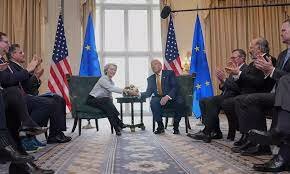
In Scotland, on Sunday 27 July, Trump and von der Leyen reached an agreement on tariffs

28/07/2025 19:49

Euroeconomie

Euroeconomies, dazi, tariffs, dazi-trump-von-der-leyen, esportazioni-, esportazioni-europee-negli-stati-uniti,

In Scotland, on Sunday 27 July, Trump and von der Leyen reached an agreement on tariffs

Per la stragrande maggioranza delle esportazioni europee negli Stati Uniti verrà applicata un'unica aliquota tariffaria del 15%

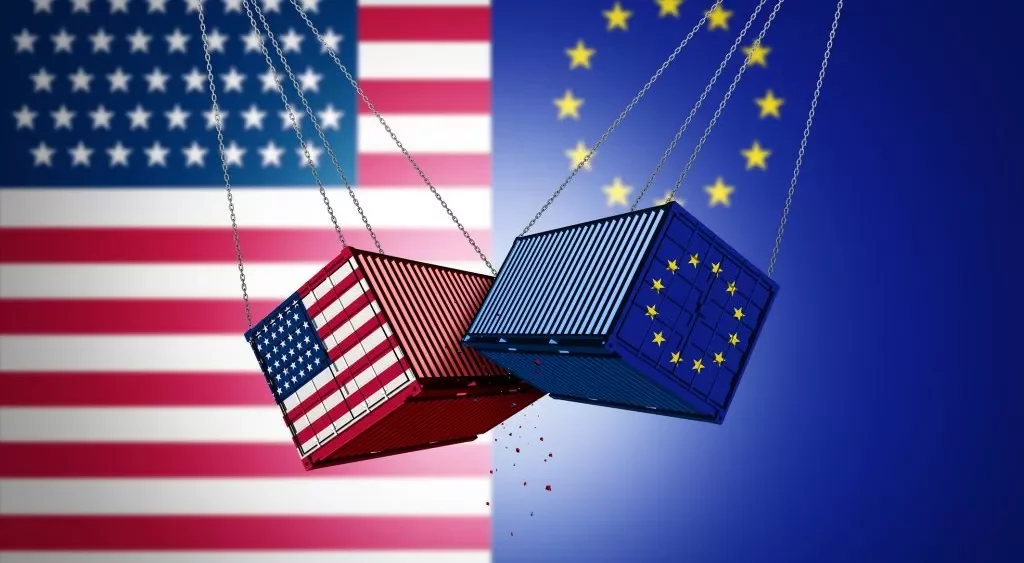
EU/ENG - On Sunday, July 27, in Scotland, United States President Donald Trump and European Commission President Ursula von der Leyen reached a landmark agreement on tariffs, marking a significant recalibration of the transatlantic trade relationship. Under the terms of the deal, the vast majority of European exports to the United States will be subject to a uniform tariff rate of 15%. This framework includes targeted exemptions for critical sectors, specifically encompassing certain generic pharmaceuticals, microprocessors, aerospace components, specialized chemical products, natural resources, and critical raw materials.

The European Union has committed to a substantial expansion of its procurement from the United States over the next three years, including energy imports valued at approximately $750 billion and significant contracts for American military hardware. Furthermore, the agreement entails a European investment pledge in the United States totaling $600 billion. Consequently, the European Union has suspended the two packages of retaliatory trade measures—collectively worth €92 billion—that were scheduled for implementation on August 7. Notably, this bilateral accord does not extend to steel and aluminum, segments currently burdened by Washington’s global 50% tariff imposition. President von der Leyen has signaled, however, that the introduction of a potential "quota system" remains under consideration to address these outstanding issues.

Conversely, the agreement provides a protected status for sensitive, high-technology industries. These “strategic products” will be exempt from tariffs, benefiting from a 0% rate. This classification covers the entire aerospace value chain—effectively signaling a truce in the protracted industrial rivalry between the European Airbus and American Boeing—alongside advanced robotics, industrial machinery, specific chemical products, generic medicines, semiconductor equipment, selected agricultural goods, and essential raw materials. Provisions are also being explored to shield spirits and alcoholic beverages from the new tariff regime.


European Economic Unit @euroeconomie.it

* This contribution is not a journalistic article but an analytical brief 


trump-vdl-.jpeg

EU/ITA - In Scozia domenica 27 luglio il presidente degli Stati Uniti Donald Trump e la presidente della Commissione europea Ursula von der Leyen hanno raggiunto l'intesa sui dazi: per la stragrande maggioranza delle esportazioni europee negli Stati Uniti verrà applicata un'unica aliquota tariffaria del 15%. Sono previste delle esenzioni per comparti specifici quali alcuni farmaci generici, alcuni microprocessori, aeronautica e loro componenti, determinati prodotti chimici, risorse naturali, materie prime critiche. 

L'Unione europea si è inoltre impegnata ad acquistare per i prossimi tre anni prodotti energetici dagli Usa per circa 750 miliardi e forniture dall'industria militare americana. L'impegno europeo riguarda anche investimenti negli Stati Uniti per circa 600 miliardi di dollari. In base all'accordo,  l'Ue accantona i due pacchetti di contromisure ai dazi da 92 miliardi di euro pronti a scattare il 7 agosto.

L'accordo Usa-Ue non riguarda l'acciaio e l'alluminio sui quali Washington ha imposto il dazio del 50% a livello globale. Su queste merci, von der Leyen ha però indicato l'introduzione di un eventuale “sistema a quote”.

Le esenzioni, invece, riguarderanno settori più sensibili e ad alta intensità tecnologica: i cosiddetti “prodotti strategici”, con tariffa a 0%, saranno salvi dai dazi. Tra questi rientrano tutti gli aeromobili e i relativi componenti, l'industria aerospaziale (tacito accordo di non belligeranza tra il colosso franco-europeo Airbus e l'americana Boeing), robotica avanzata e macchinari industriali, alcuni prodotti chimici, alcuni farmaci generici, apparecchiature a semiconduttori, alcuni prodotti agricoli, risorse naturali e materie prime essenziali. Anche liquori e alcool potrebbero essere risparmiati.


European Economic Unit @euroeconomie.it *

* This contribution is not a journalistic article but an analytical brief - Questo contributo non è un articolo giornalistico ma un brief analitico 


facebook
instagram
twitter
linkedin
whatsapp
X

@2021-2023 EUROECONOMIES

WEBSITE CREATED BY Q DIGITALY

Create Website with flazio.com | Free and Easy Website Builder